




Proyecto LLBI Sense
Fermentation is a metabolic process in which microorganisms such as bacteria, yeast, or fungi convert organic substrates—mainly sugars—into simpler compounds such as alcohols, organic acids, or gases. Traditionally associated with food and beverage production, its importance has grown significantly in recent decades due to its central role in modern biotechnology and sustainable industrial processes.
Today, fermentation is one of the most relevant biotechnological platforms worldwide. Its rapid expansion is driven by the increasing demand for biologically derived products (such as pharmaceuticals, enzymes, biopolymers, and functional foods) as well as the need for more efficient and sustainable alternatives to conventional chemical synthesis. As a result, fermentation processes are widely used across industries including food, pharmaceuticals, biofuels, and the production of high-value-added compounds.
A bioreactor is the system in which fermentation takes place under controlled conditions. It is a vessel designed to support and optimize microbial growth and product formation by regulating key parameters such as temperature, pH, dissolved oxygen, agitation, and nutrient supply. Precise control of these variables is essential, as even small deviations can significantly affect process performance and product quality.
Modern bioreactors are equipped with a wide range of sensors that enable real-time monitoring of the process. Common sensors include those measuring pH, temperature, dissolved oxygen (DO), pressure, and flow rate, as well as indirect biomass estimation systems. In parallel, advanced non-invasive techniques such as spectroscopy, ultrasounds and image analysis are increasingly being integrated, allowing for the assessment of culture state without the need for destructive sampling. These technologies open the door to more sophisticated control strategies based on predictive modeling.
In this context, the modeling of fermentation variables using image analysis and non-destructive methods is an area of growing interest. It enables more automated, robust, and efficient processes, reducing reliance on offline measurements and improving the ability to respond dynamically to changes within the system.
Furthermore, the large volumes of data collected by modern non-invasive techniques, along with the predictive models developed from them, promote the exploration of Artificial Intelligence (AI), which can be applied to these bioprocesses. In this line, AI is capable of controlling and optimizing fermentation processes carried out in bioreactors by integrating real-time data from multiple sensors and non-invasive monitoring systems. Through advanced machine learning algorithms, it can identify patterns, predict process evolution, and dynamically adjust operational parameters such as pH, temperature, aeration, and agitation. This enables improved process stability, increased productivity, and enhanced product consistency, while also reducing the need for manual intervention and offline sampling.
Among the modern non-invasive techniques, image analysis stands out due to its ability to provide continuous, real-time, and information-rich monitoring of the fermentation process without interfering with the system. Unlike traditional sampling methods, it enables the extraction of quantitative and qualitative features related to microbial growth, morphology, aggregation, and overall culture dynamics directly from visual data.
Furthermore, image analysis can be easily integrated with advanced computational tools, including machine learning and artificial intelligence algorithms, allowing for automated feature extraction and improved predictive capability. Its relatively low cost, scalability, and adaptability to different bioprocess configurations make it a particularly attractive approach for both laboratory-scale research and industrial applications. Within imaging techniques, laser-backscattering imaging (LLBI) characterizes the extinction of light transmittance across a changing magnitude measured in a given matrix. This principle is the basis of a wide range of analytical methods. However, in this case, imaging analysis and data mining techniques are followed to study the generated diffraction patterns because matrix-light interactions. In food-processing research, laser-backscattering imaging has been applied for modelling different food matrix transformations due to enzymatic action.
Based on the context described, the main objectives of the project can be defined as follows:
The primary objective is to develop a predictive and data-driven framework for the modeling of fermentation processes in bioreactors using image analysis and non-destructive monitoring techniques. This framework aims to extract meaningful process information from real-time data and translate it into reliable estimations of key fermentation variables.
A second objective is to investigate the relationship between visual and sensor-based signals and the underlying biochemical and physical states of the culture. In particular, the project seeks to determine how features extracted from image data can be correlated with critical process variables such as biomass concentration, growth phase, and overall process performance.
Another key objective is to design and evaluate machine learning and artificial intelligence models capable of predicting fermentation dynamics. These models should be able to integrate multi-source data, including imaging and conventional sensor measurements, to improve prediction accuracy and robustness.
In addition, the project aims to explore the potential of these AI-driven approaches for real-time monitoring and control of bioreactors. This includes assessing their suitability for supporting decision-making and enabling adaptive control strategies that optimize process conditions automatically.
Finally, the project seeks to contribute to the advancement of more efficient, scalable, and non-invasive bioprocess monitoring systems, reducing dependence on traditional destructive sampling methods and paving the way toward more autonomous fermentation platforms.
Material and methods
Imaging device and capture
A low-cost imaging device was designed based on Verdú et al. (2020) in order to collect information from each sampling time generated by light-matrix interactions. The objective was to use images to collect the variance generated in the matrix during fermentation by capturing the diffraction patterns transmitted due to laser-matrix interaction at each sampling time inside the tank. Fig. 1-A shows a scheme of the device setup.
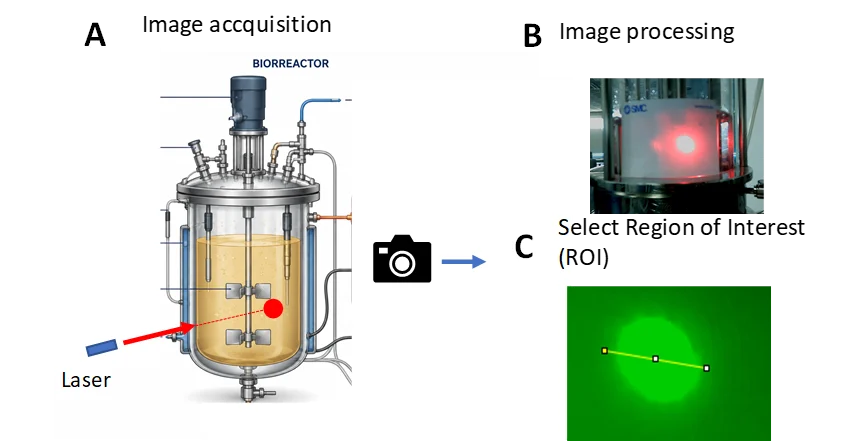
Fig 1. Capture device and image processing schemes. A: Capture system configuration. B: Images processing. C: Select Region of Interest (ROI).
Parallel fermentation data will also be measured to correlate the image-derived variables with key fermentation parameters, such as cell density measured by spectrophotometry and total cell counts determined using agar plate assays.
For this purpose, the objectives of this project can be summarized as follows:
- Design, adapt and optimize the image capture device
- Examine the possible image-derived variables
- Model the changes recorded
- Correlate changes with measurable variables
- Study the scalability in pilot and industrial bioreactors
This project was developed by Sergio Hernández, Head of R&D at Techmi Group, and by Cade Medearis and Jake Holfinger, interns from the United States. If you’d like to learn more about the project, check out the video, which explains how the laser works in greater detail.