


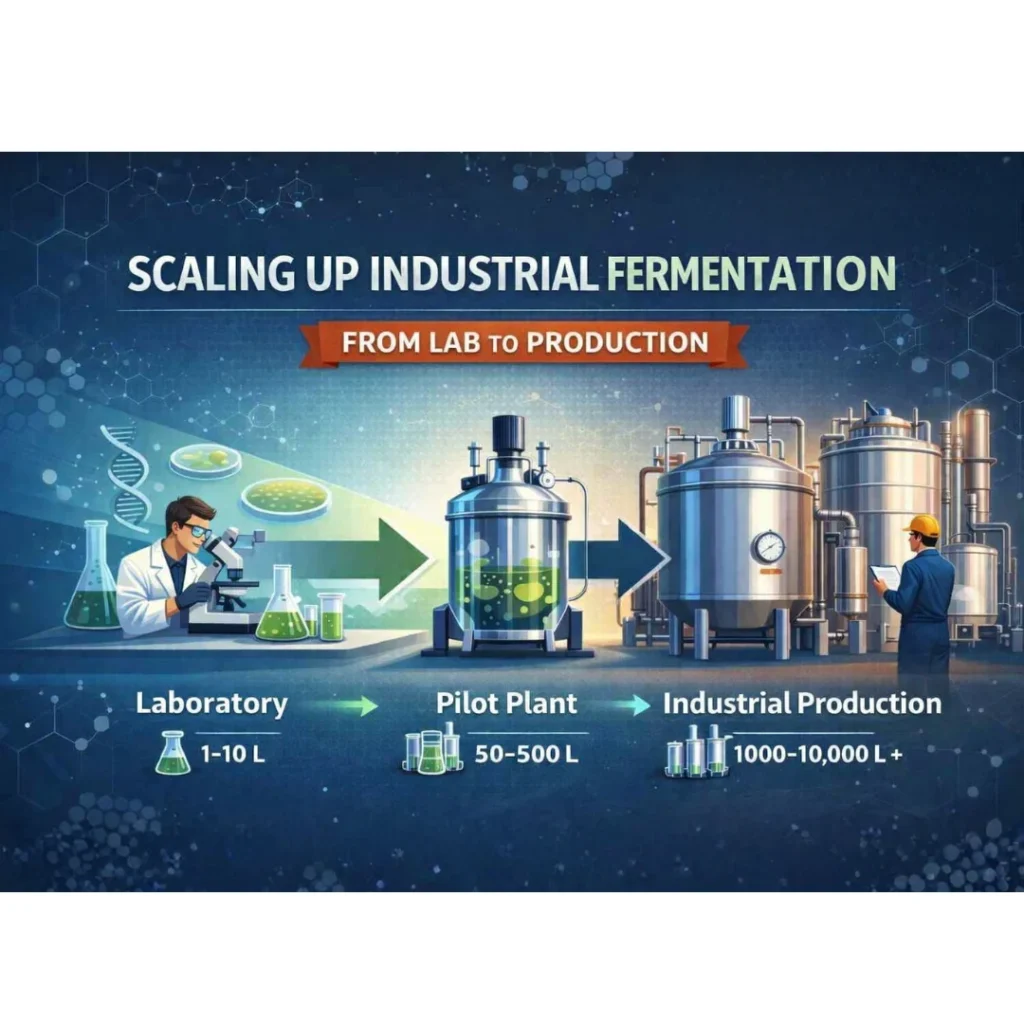


In biotechnology, many innovations begin in the laboratory:
Microorganisms produce enzymes, generate novel compounds or develop an industrial process.
In small-scale reactors, everything works well. But when moving to industrial-scale production, a key challenge arises:
How can a fermentation process be scaled up without compromising efficiency or quality?
If your answer involved a fermentation scale-up, I must say you’re spot on.
Fermentation scale-up allows you to increase production volume whilst maintaining optimal process conditions.
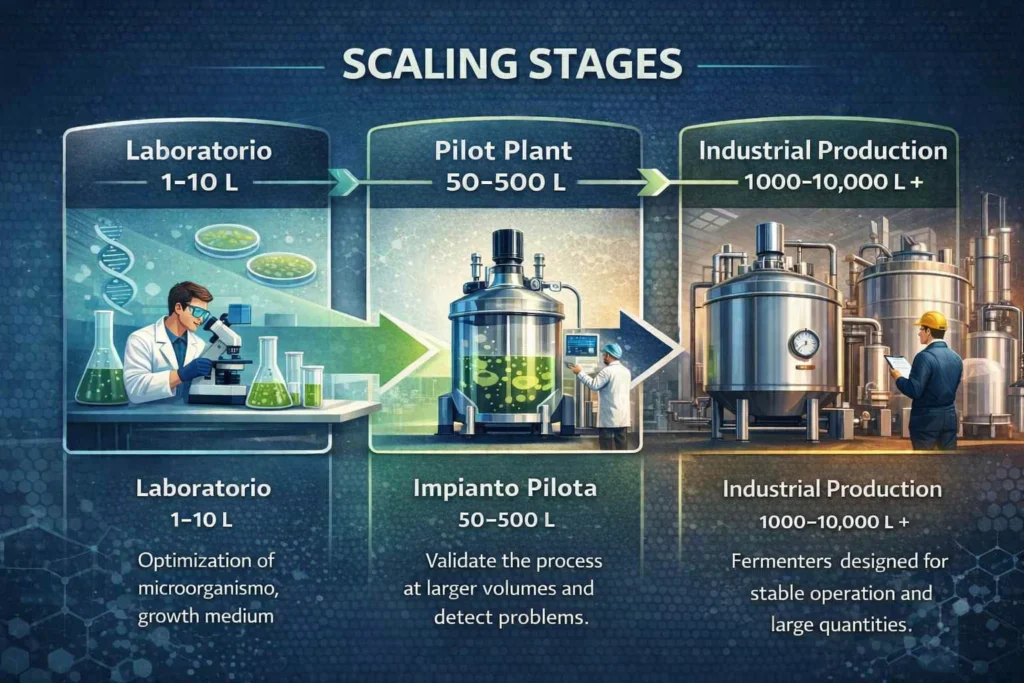
Stages of climbing:
- Laboratory (1–10 L): optimisation of the microorganism, culture medium and basic parameters.
- Pilot plant (10–50 L): to validate the process at larger scales and identify any issues.
- Industrial production (from 100 L): fermenters designed to operate stably and produce large quantities.
However, we must bear in mind that scaling involves a number of challenges.
As the reactor volume increases, significant challenges arise:
- Oxygen transfer (kLa): Essential in aerobic fermentation; it depends on aeration and agitation.
- Mixing the medium: To prevent areas with differences in nutrients, oxygen or temperature.
- Temperature control: Metabolic heat builds up; this is regulated using cooling jackets or heat exchangers.
- pH control: Essential for product stability; it is regulated using sensors and automated systems.
Many will be wondering, ‘How can we overcome these challenges?’
Well, we could say that much of the success depends on the design of the bioreactor: its geometry and materials, its mixing and aeration systems, and its automation sensors.
A suitable design ensures stable and reproducible processes, even at high production volumes.
Another point of great importance is the pilot plant.
Pilot plants enable:
- Validate the process on a larger scale.
- Optimise operational parameters.
- Mitigate risks before investing in industrial production.
This is a crucial step in ensuring the viability of any industrial bioprocess.
In conclusion, scaling up a process requires advanced biotechnology combined with engineering focused on efficient, stable and scalable processes. And at Techmi Group, we know a thing or two about this: we have been designing industrial fermentation systems for over 25 years, from pilot plants to full-scale production facilities.
Turning laboratory innovations into reliable industrial solutions.
Get in touch with our engineers and find out how to take your bioprocess to the next level.